Apogee
AI-Powered Grant Evaluation, Education, and Efficiency Ecosystem
Institutional support for research and education is essential for advancing knowledge and innovation. Securing external funding through grants is a critical aspect of this support, enabling researchers, educators, and institutions to pursue their scholarly and creative endeavors. However, the grant application and management process can be complex, time-consuming, and resource-intensive, posing challenges for researchers and administrators alike.
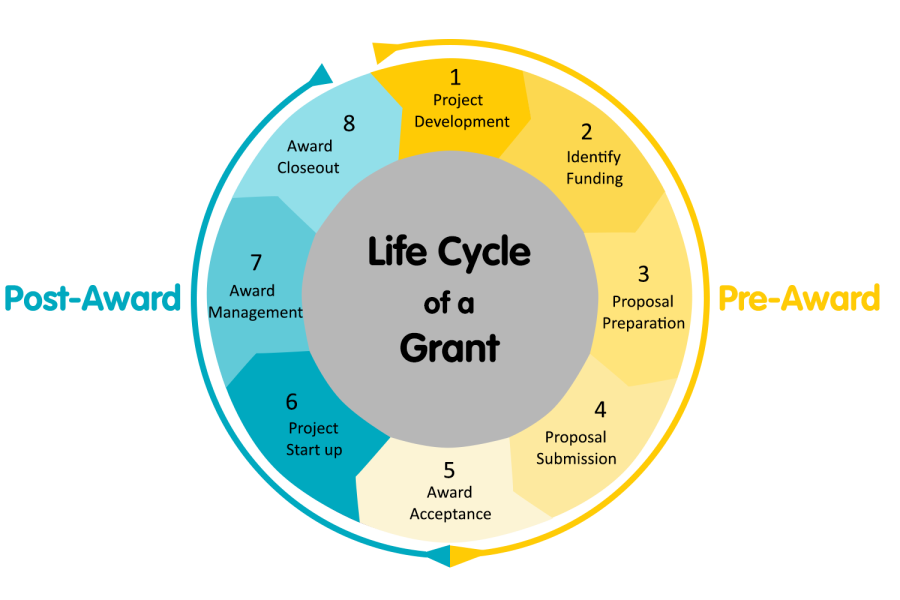
Securing and managing grants is a multi-stage process, depicted in Figure 1, that involves project development, funding identification, proposal submission, award administration, and reporting. Artificial Intelligence (AI) and Machine Learning (ML) have potential applications throughout the grant lifecycle, potentially improving efficiency, reducing administrative burdens, and enhancing research and educational outcomes. Table 1 outlines a few (not exhaustive) specific ways AI/ML can support each phase of the grant lifecycle.
| Grant Lifecycle Stage | AI/ML Role in Education, Research, and Administration |
|---|---|
| 1. Project Development | AI-powered literature reviews and automated topic identification using NLP. Recommender systems for relevant research gaps. |
| 2. Identify Funding | AI-based funding opportunity matching, automated alerts for relevant grants, and predictive analytics for funding success. |
| 3. Proposal Preparation | AI-assisted writing tools for generating proposals, automated compliance checking, and past proposal analysis for insights. |
| 4. Proposal Submission | AI-driven document validation, deadline tracking automation, and grant submission workflow optimization. |
| 5. Award Acceptance | AI-supported contract analysis, budget validation, and automated notifications for compliance requirements. |
| 6. Project Start-up | AI-powered onboarding tools for project teams, automated scheduling, and integration of administrative tasks. |
| 7. Award Management | AI-based financial tracking, automated reporting tools, and predictive analytics for resource allocation. |
| 8. Award Closeout | AI-driven final report generation, compliance audits, and impact assessment using NLP and machine learning. |